Jointly initiated by: GreyBay Institute, Greater Bay Area Institute
Tel: +86 13538048576Address: 8 Yuanling 5th Street, Futian District, Shenzhen, Guangdong, China


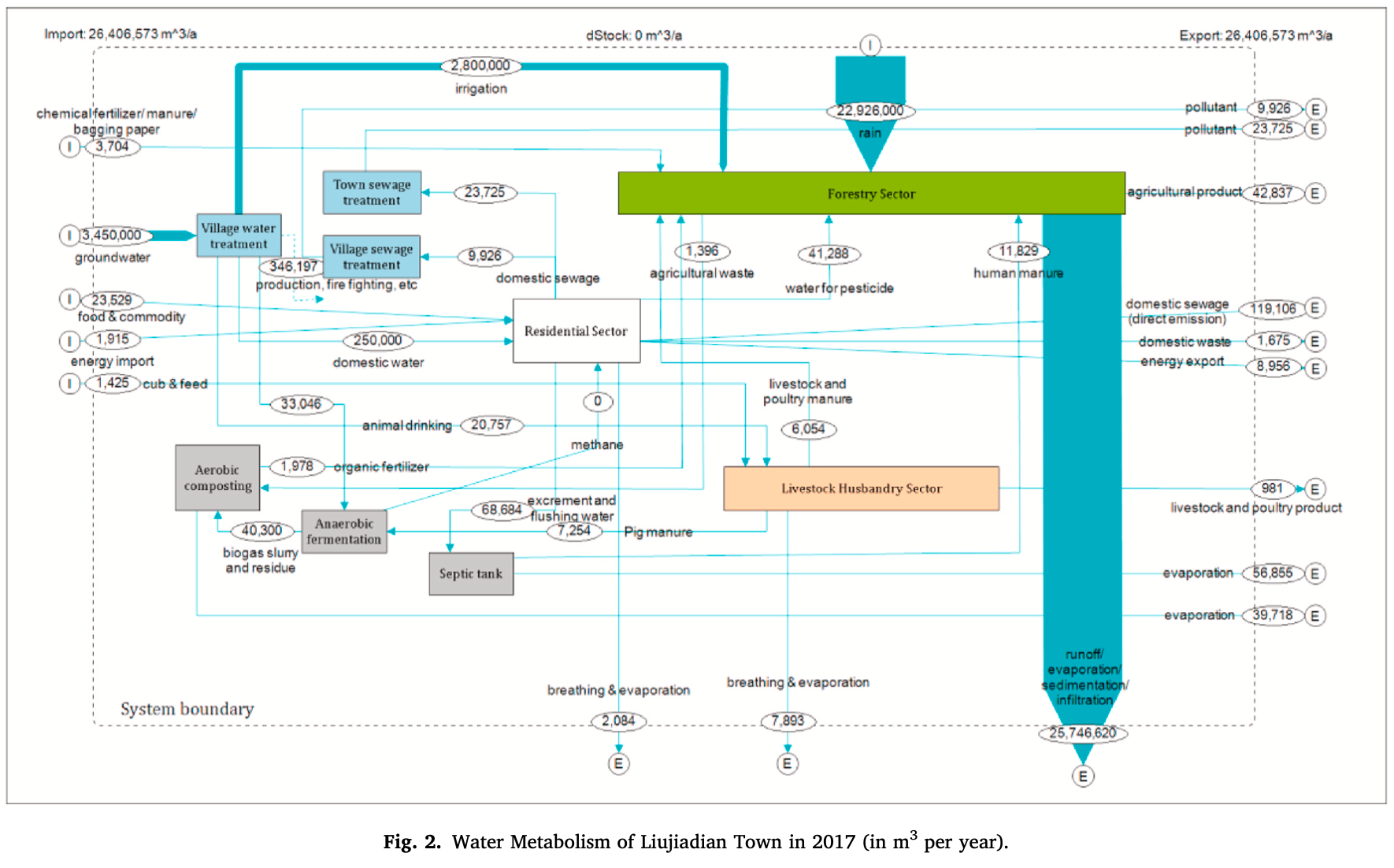
In January 2021, GreyBay Institute and the team of Professor Zongguo Wen at Tsinghua University’s School of Environment published a paper in the Journal of Environmental Management entitled “Water-energy-nutrient nexus: Multi-sectoral metabolism analysis and technical path optimization for eco-towns.” The study addresses policy bottlenecks in China’s eco-town development—low resource recycling efficiency and weak cross-sector coordination—by building a quantifiable, replicable decision-support tool to support local governments in choosing waste valorisation technologies.
Using Liujiadian Town in Beijing as a case study, the team developed a multi-sector metabolism analysis model for rural areas (MMAM-rural) that maps flows of water, energy, carbon, nitrogen, and phosphorus across five sectors: water supply, waste treatment, livestock, forestry, and residential life. The model identifies key metabolic bottlenecks and enables coordinated optimisation of waste management across agriculture, environment, and water authorities within a single analytical framework.
The work has three direct policy applications: (1) ex ante simulation and ex post evaluation for eco-town planning, avoiding ad hoc technology choices; (2) validation of optimal technology bundles—e.g. crop residue (edible fungus cultivation + anaerobic digestion + composting), livestock waste (anaerobic digestion + composting), and food waste (anaerobic digestion + composting)—that can inform local waste valorisation guidelines; (3) evidence that single-technology subsidies are limited, with a recommendation to shift fiscal incentives to evaluated integrated solutions for better use of public funds.
The study also supports cross-sector governance. Results show that integrated planning and shared facilities—e.g. co-locating food waste treatment with sewage anaerobic digestion—yield significant resource synergies. These findings have been reflected in policy briefings to relevant agencies and support the case for inter-departmental coordination and “zero-waste town” governance.
Building on this framework, the team now offers tailored consulting for local governments and planners: localised parameterisation of technical pathways, carbon reduction accounting for waste valorisation projects, and design of ecosystem product value mechanisms. The project is an early collaboration between Tsinghua’s School of Environment and GreyBay Institute in the “urban metabolism and healthy cities” space; the two will continue to work together on urban environmental health impact assessment and low-carbon healthy community standards.
The decision-support tool and policy pathway from this study can inform green low-carbon town building, near-zero carbon pilot zones, and “zero-waste city” initiatives in Shenzhen and the Greater Bay Area. For enquiries on methods, policy translation, or custom assessment: contact@greybay.org, research@greybay.org.
Publication:
Water-energy-nutrient nexus: Multi-sectoral metabolism analysis and technical path optimization for eco-towns. Zongguo Wen et al. Journal of Environmental Management, 2021 Jan 1;277:111395.
DOI: 10.1016/j.jenvman.2020.111395 │ PMID: 33038671
Link: https://pubmed.ncbi.nlm.nih.gov/33038671/
Jointly initiated by: GreyBay Institute, Greater Bay Area Institute
Tel: +86 13538048576Address: 8 Yuanling 5th Street, Futian District, Shenzhen, Guangdong, China