Jointly initiated by: GreyBay Institute, Greater Bay Area Institute
Tel: +86 13538048576Address: 8 Yuanling 5th Street, Futian District, Shenzhen, Guangdong, China



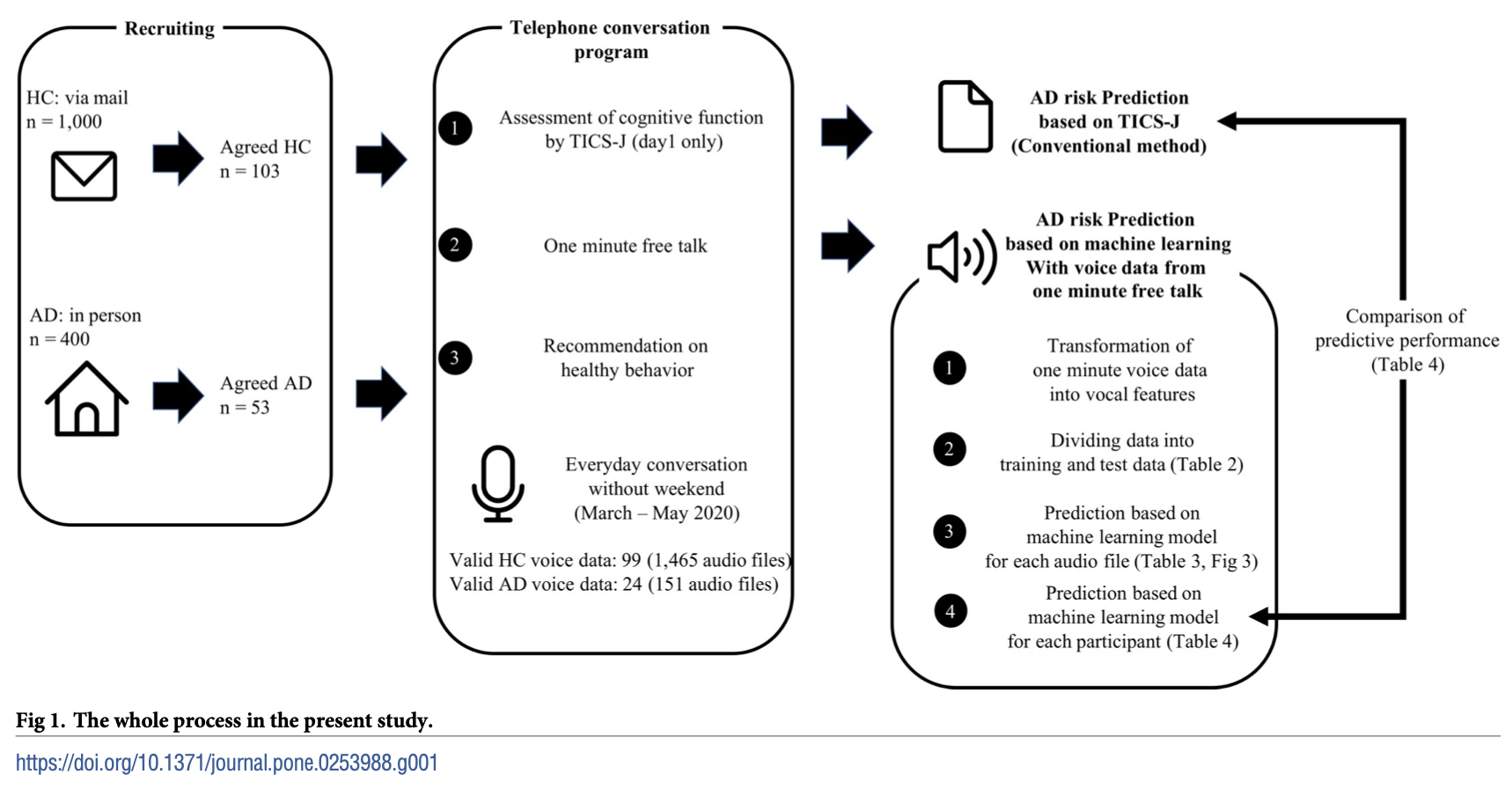
In July 2021, a GreyBay Institute visiting senior researcher based at the Harvard T.H. Chan School of Public Health and collaborators published Dementia risks identified by vocal features via telephone conversations: a novel machine learning prediction model in PLOS ONE. The study showed that recordings from older adults' everyday phone conversations with an AI system can identify Alzheimer's disease risk with high accuracy, opening a scalable pathway for low-burden community screening.
Working with the Kyoto University team, the researchers analysed 1,616 audio files collected through a dementia-prevention programme in Hachioji, Japan, from March to May 2020. The dataset covered 99 healthy controls and 24 people with mild to moderate Alzheimer's disease. Using PRAAT, the team extracted 60 acoustic features spanning pitch, intensity, speech rate, pause duration, and spectral centroid, then built prediction models with XGBoost, random forest, and logistic regression for comparison against the established Japanese TICS-J telephone cognitive assessment.
The models showed strong translational potential. For single audio files, all three algorithms achieved AUC values of 0.86-0.89. When mean predictions across all recordings for each participant were used, both XGBoost and random forest reached an AUC of 1.000, outperforming the TICS-J score of 0.917. In practical terms, that means near-perfect dementia-risk stratification may be possible from one minute of daily free speech recorded over two weeks.
From a public-health perspective, the study demonstrated the feasibility of passive, non-invasive, zero-burden mass screening. Traditional cognitive screening depends on trained personnel and 15-30 minute structured assessments, whereas this approach can use ordinary call data from community hotlines or public-service systems without extra devices or active patient effort. The study also identified a set of promising acoustic biomarkers linked to Alzheimer's pathology, including longer silent pauses, lower pitch variability, and shifts in spectral features.
The authors also highlighted important cautions. The perfect separation between healthy controls and diagnosed patients must be tested carefully in larger prospective cohorts, because the current findings may reflect case-control design and limited sample size. Still, sensitivity analyses suggested that detectable acoustic changes already appear in earlier disease stages, including mild to moderate cases and people with subjective cognitive decline.
GreyBay has since launched the "Voices of Pengcheng" validation project with partners in Shenzhen, aiming to recruit 2,000 adults aged 65 and over across three districts for a two-year prospective cohort. The goal is to establish a voice-based cognitive-decline trajectory model for Chinese populations and derive cross-culturally useful acoustic biomarker thresholds. GreyBay also supports local deployment, anonymised analysis of hotline audio, and evaluation tools for dementia-friendly community interventions. For enquiries, please contact contact@greybay.org.
Publication:
Dementia risks identified by vocal features via telephone conversations: A novel machine learning prediction model. Yue Li et al. PLOS ONE, 2021 Jul 14;16(7):e0253988.
DOI: 10.1371/journal.pone.0253988 | PMCID: PMC8279312
Link: https://pmc.ncbi.nlm.nih.gov/articles/PMC8279312/

Jointly initiated by: GreyBay Institute, Greater Bay Area Institute
Tel: +86 13538048576Address: 8 Yuanling 5th Street, Futian District, Shenzhen, Guangdong, China