Jointly initiated by: GreyBay Institute, Greater Bay Area Institute
Tel: +86 13538048576Address: 8 Yuanling 5th Street, Futian District, Shenzhen, Guangdong, China


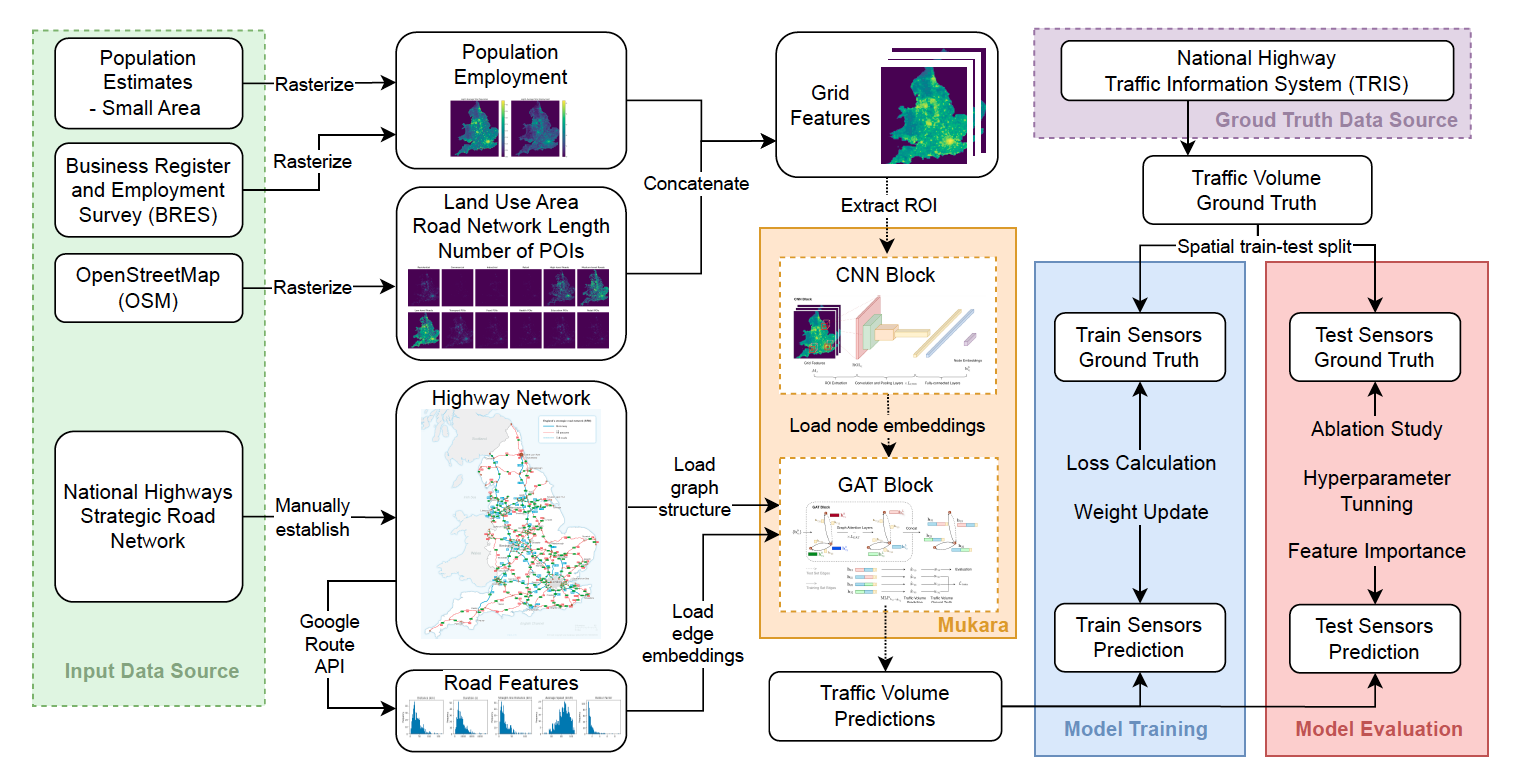
GreyBay Institute researchers, working with the Department of Architecture at the University of Cambridge, published Mukara: a deep learning alternative to the four-step travel demand model with a case study on interurban highway traffic prediction in the UK. The paper tackles a long-standing question in strategic transport modelling: how to predict traffic volumes across large road networks without relying on traditional origin-destination surveys and extensive manual calibration.
For decades, the four-step model has been the dominant framework for transport planning, but it depends on static survey inputs, substantial hand-tuning, and strong behavioural assumptions. Data-driven models can capture complex nonlinear relationships, yet most have focused on short-term forecasting rather than long-term, segment-level demand estimation for strategic planning. Mukara was developed to close that gap by learning a direct mapping from external socioeconomic and spatial features to observed traffic flows.
The model was trained on eight years of traffic observations from England and Wales, using inputs such as population, employment, land use, road-network characteristics, and points of interest. Without relying on conventional OD survey data or historical flow time series, Mukara predicts daily traffic volumes on key motorway segments. Under random cross-validation, it achieved a mean GEH of 50.74, a mean absolute error of 8,989 vehicles per day, and an R^2 of 0.583, outperforming several baseline models and comparable methods reported in the literature.
The study also tested the model under more demanding region-based spatial cross-validation. Mukara maintained relatively robust performance in geographically independent test areas, indicating strong spatial transferability. That property is especially important for national-scale networks, data-sparse areas, and future planning scenarios where observed traffic counts may be limited.
Ablation experiments further examined the contribution of different feature groups and model components. The results showed that the architecture is robust and that different types of external information contribute in distinct ways to traffic formation. More broadly, the paper demonstrates how deep learning can support long-term transport-demand modelling and open new pathways for urban and regional planning.
As one of GreyBay's key outputs in transport modelling, spatial intelligence, and urban systems, Mukara highlights the feasibility of bringing AI into traditional planning practice. The team will continue to develop more interpretable and more spatially generalisable theory-guided transport models in support of healthy cities, low-carbon mobility, and sustainable regional development.
Publication:
Mukara: a deep learning alternative to the four-step travel demand model with a case study on interurban highway traffic prediction in the UK.
Yue Li, Shujuan Chen, Ying Jin.
Publication details to be added

Jointly initiated by: GreyBay Institute, Greater Bay Area Institute
Tel: +86 13538048576Address: 8 Yuanling 5th Street, Futian District, Shenzhen, Guangdong, China